
Residential Property Management Dilemma: time for a Transparent Pass-through (TPM) Model

Updated: Jul 25
Residential Property Management Dilemma: time for a Transparent Pass-through (TPM) Model
Shiv Vadrewu
The Hyderabad Residential landscape is breath taking. Some facts:
ANAROCK Residential Market Viewpoints (Q1 2026): there are about 103,000 units available or under construction supply
ANAROCK India Research (Q1 2026): New Quarterly Launches (Q1 2026) about 19,300 residential units (87% YoY increase)
JLL India Residential Market Intelligence / Knight Frank: Gated Community Dominance. >68% of new launches (Led by West Hyderabad: Kokapet, Tellapur, Narsingi, Puppalguda)
ANAROCK Property Consultants (Q1 2026): Average Base Selling Price. ₹7,990 per sq. ft.
These are mind-blowing and mind-bending facts. When extrapolated across India, the sheer magnitude of the real estate boom in India is hard to envisage. This prompts the question: what is the state of upkeep of all this residential infrastructure, especially after handover by builder to Resident Welfare Associations (RWAs, hereafter)? Does the current Integrated Facility Management (IFM, henceforth) business model serve the diverse needs of the multitude of condominiums sprouting across the country? I differ. This article suggests an alternative model.
With infrastructurally complex and diverse condominiums emerging, the pressure of containing the recurring monthly maintenance costs sets in soon after RWAs take operational control from builders. While not crossing the GST threshold in maintenance is a serious concern for many, it is not so for the premium condos. Current IFM models suit the premium condominiums well. It takes over vendor management on a turnkey basis with vendor markups which are inherently cost-inflationary. The conventional IFM model is:
Cost-cascading: Traditional IFM companies load hidden margins ( add GST to them) which could raise maintenance costs upwards of 15%. For a 1000 apartment complex, paying say, Rs 40L per month to vendors, the markup is a sizable: Rs 6L per month.
Foments GST vs Non-GST politics. There are condos with a mix of 2,3, 4 bedroom apartments. There are cases where 2 and 3-bedroom apartments fall below the GST threshold while 4-bedrooms fall above; leading to resident-politics relating to GST-input tax credit utilization. I came across a case where residents paying GST insisted on limiting utilization of input-tax credit only for those apartments paying GST. Hilarious!
Clearly, IFM is not a panacea for Facility Management for all. Enter, Transparent Pass-through Model (TPM). Let me explain:
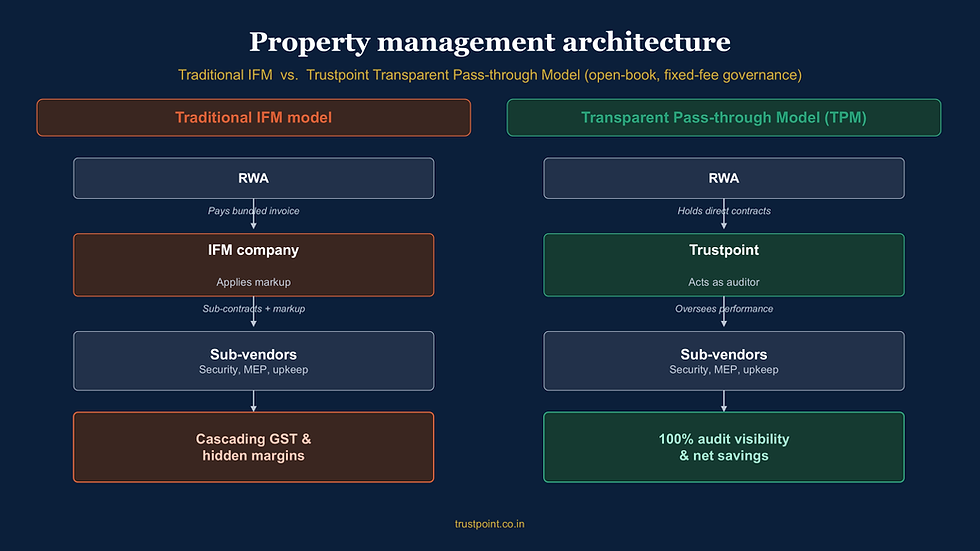
TPM minimizes cost-cascading. As in the graphic below: TPM works on Pass-through costs + Management fee. Pass-through costs include General Manager/ Facilities Manager salaries, routine travel, boarding & Lodging and other miscellaneous costs, if any. TPM deliberately keeps the rest of the staff on RWA rolls to minimize hidden markups. It fiercely focuses on minimizing costs.
TPM facilitates RFQs/ Tenders for RWAs ( on management fee-basis) but ensures that contracts are executed between vendors and RWAs. No markups here. By keeping vendor contracts directly with the RWA, TPM eliminates double-margin stacking and lowers GST impact, saving the society 15% (at least) on total annual operational costs.
TPM emphasizes robust contracts which are transparent and SLA (Service Level Agreement) driven. No free lunch for vendors. Management Fee is broken down on clearly defined SLAs. The greater the clarity here, the lesser the friction and no delays in vendor remuneration. In fact, vendors are self-driven, guided by the need to hit SLAs.
TPM offers free walkthrough cost audits and emphasizes a cost-optimization mindset. It does not work on specific cost-optimization targets but strives to build a saving-mindset. In our hotel property in Shirdi managed by our company, Trustpoint Property Solutions, we leverage TOD electricity billing (Time of Day billing) by shutting off Heat Pumps when there is a price surge in peak hours ( 5pm to 12am). A small example.
TPM avoids potential conflict of interest: Trustpoint acts as an unbiased auditor and controller. Since Trustpoint takes zero profit from vendor contracts, its sole incentive is enforcing strict SLAs on behalf of the RWA.
TPM gives complete Financial transparency and accountability. Every vendor invoice, salary breakdown (GM/FM), and maintenance expenditure is direct, audited, and visible down to the exact rupee to the RWA management.
As the graphic below shows: TPM is an Open-Book Pass-through model of Facility Management.
TPS offers TPM: Trustpoint Property Solutions offers Transparent Pass-through Model.


Comments